Efficient Patterns for Claude Fable 5: Smart Strategies to Cut AI Costs Without Sacrificing Quality_
In the world of Artificial Intelligence (AI), operational costs are often a major challenge, especially when dealing with highly intelligent but expensive AI models. Based on recent updates from the Claude development team (@ClaudeDevs), there is a smart solution to this problem: combining two AI models, Fable 5 (the larger, highly intelligent, and more expensive model) with Sonnet 5 (the fast, efficient, and more affordable workhorse model).
For those new to these technical terms, imagine every word or piece of a word processed by AI is counted as a "token." The more tokens a large model reads and writes, the more expensive it gets. Therefore, strategic collaboration between these two models is essential.
Here are two main strategies (patterns) that are highly efficient and easy to understand, designed to balance high performance with cost savings:
1. Pattern One: Using Fable 5 as an "Advisor"
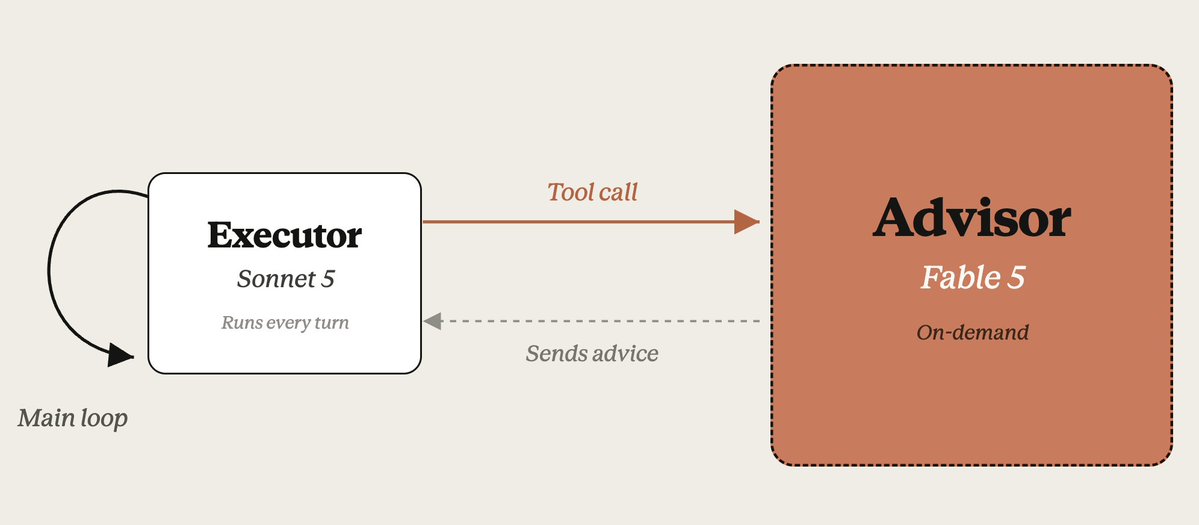
Imagine you own a company. Instead of asking a Senior Director (Fable 5) to do repetitive daily operational tasks, you assign a capable Junior Staff member (Sonnet 5) to execute the majority of the work. This Junior Staff member will only approach the Senior Director when they hit a roadblock or need high-level strategic guidance.
In this pattern, the main role of the executor is held by Sonnet 5. Sonnet 5 will then call Fable 5 only when it needs specific guidance, direction, or advice. The financial advantage is clear: the vast majority of your token usage will be billed at the much lower Sonnet 5 rate.
Real Evidence (Testing on SWE-bench Pro): (Note: SWE-bench is an industry standard test to see how smart an AI is at solving real-world programming/coding problems.)
The combination of Sonnet 5 + Fable 5 advisor tool manages to achieve ~92% of the total intelligence (performance score) of Fable 5 alone, but at a highly efficient cost, which is only ~63% of the normal price.
In practice, Fable 5 is called very rarely (about once per major task) purely to provide steering, while Sonnet 5 executes the heaviest portion of the task from start to finish.
- Learn the technical details in the official documentation: Advisor Tool - Claude Platform

2. Pattern Two: Using Fable 5 as an "Orchestrator"
The second strategy reverses their roles. This time, imagine Fable 5 as a brilliant Project Manager. The manager's job is to break down a large, complex project into structured, smaller stages (making plans). Once the plan is finalized, they delegate those specific tasks to their team of workers, which is Sonnet 5.
Once again, because the heavy tasks that consume a lot of time and research (which means consuming a massive amount of "tokens") are executed at the worker level, the cost is calculated based on the affordable Sonnet 5 rate. Fable 5 only consumes tokens for the planning and result validation stages.

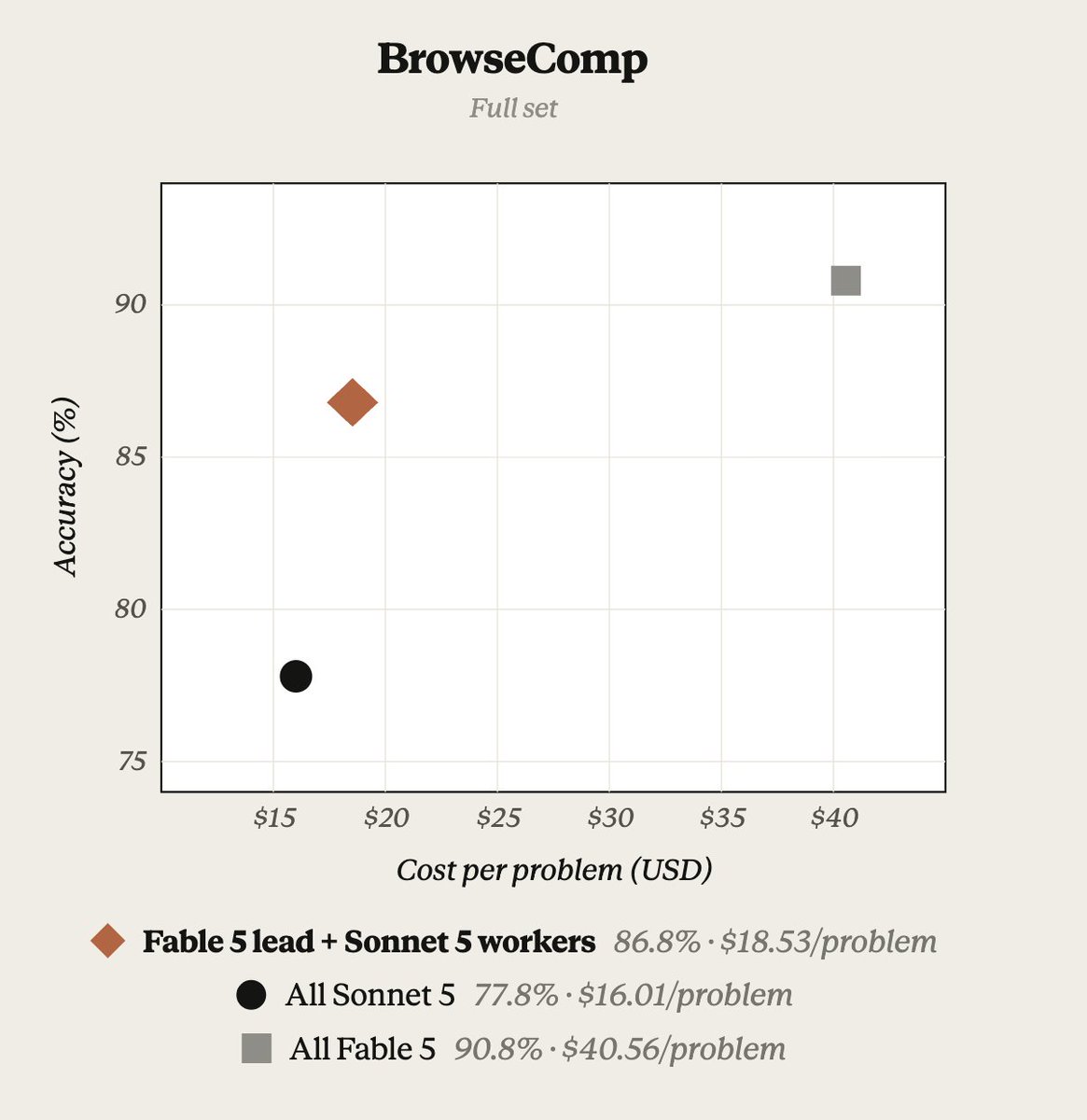
Real Evidence (Testing on BrowseComp): (Note: BrowseComp is a comprehensive test to see how well an AI can independently research, browse the web, and find exact information.)
In testing using the Claude Managed Agents ecosystem with a combination of Fable 5 orchestrator + Sonnet 5 worker sub-agents, the team found incredible results.
This managerial system successfully achieved 96% of pure Fable 5's genius performance, but its operational costs plummeted to just 46% of its normal price. The secret lies in delegating all token-heavy research to Sonnet 5.
- See programming implementation examples in the Cookbook: CMA_plan_big_execute_small.ipynb
Full Support from the "Claude Managed Agents" System
How can you implement this automatically? Anthropic has provided an infrastructure called Claude Managed Agents. This system makes it easy for users to build "Sub-Agents" (small, independent AI programs that work and coordinate under the control of a main AI).
This system gives you the flexibility of building a corporate organizational structure:
- Escalate up: A confused worker agent can report and ask for expert advice from the Fable 5 advisor.
- Delegate down: A manager agent (Fable 5) that receives a giant task can distribute it to the Sonnet 5 workers.
Extra Savings Feature: Independent Cache System Another highly profitable feature of this agent architecture is that each sub-agent keeps its own cache (context memory).
Think of a "cache" like an AI that has already read your company's thick rulebook. If you give it a repetitive task, you don't have to pay the system to make the AI "re-read" that thick book from page one every single time. With a cache in each agent, repeated billing for the same initial context can be drastically reduced.
- Full documentation on multi-agents: Claude Managed Agents - Multi-agent
Conclusion
For application developers, startups, and business owners, this multi-agent collaboration opens up revolutionary new opportunities. You no longer have to be stuck in the dilemma of choosing between "cheap but often wrong AI" or "genius AI that blows up the budget." By implementing either the Advisor or Orchestrator pattern, you can enjoy the best performance of today's AI at a very reasonable cost.
Main References:
Related Posts.

AI's Insatiable Appetite: Why AI Servers Will Consume More Power Than Traditional Data Centers by 2027
Explore Gartner's forecast on the massive surge in AI data center power demand, why GPUs require so much energy, and how it strains global electrical grids.
Search Console Can Now Track How Your Social and Video Content Performs on Google Search
Google has launched Platform Properties in Search Console, a new way to see how your Instagram, TikTok, X, and YouTube content performs on Google Search and Discover.

Google Maps Demo Key: How to Learn the Google Maps API Without a Credit Card
Want to learn the Google Maps API without a credit card? Meet the Google Maps Demo Key, a new way to get a free API key with no billing account required.